Inverter Settings
The Inverter screen provides access to device information, diagnostics, and all configurable settings for your inverter or gateway. Sections are collapsible - tap a section header to expand it.
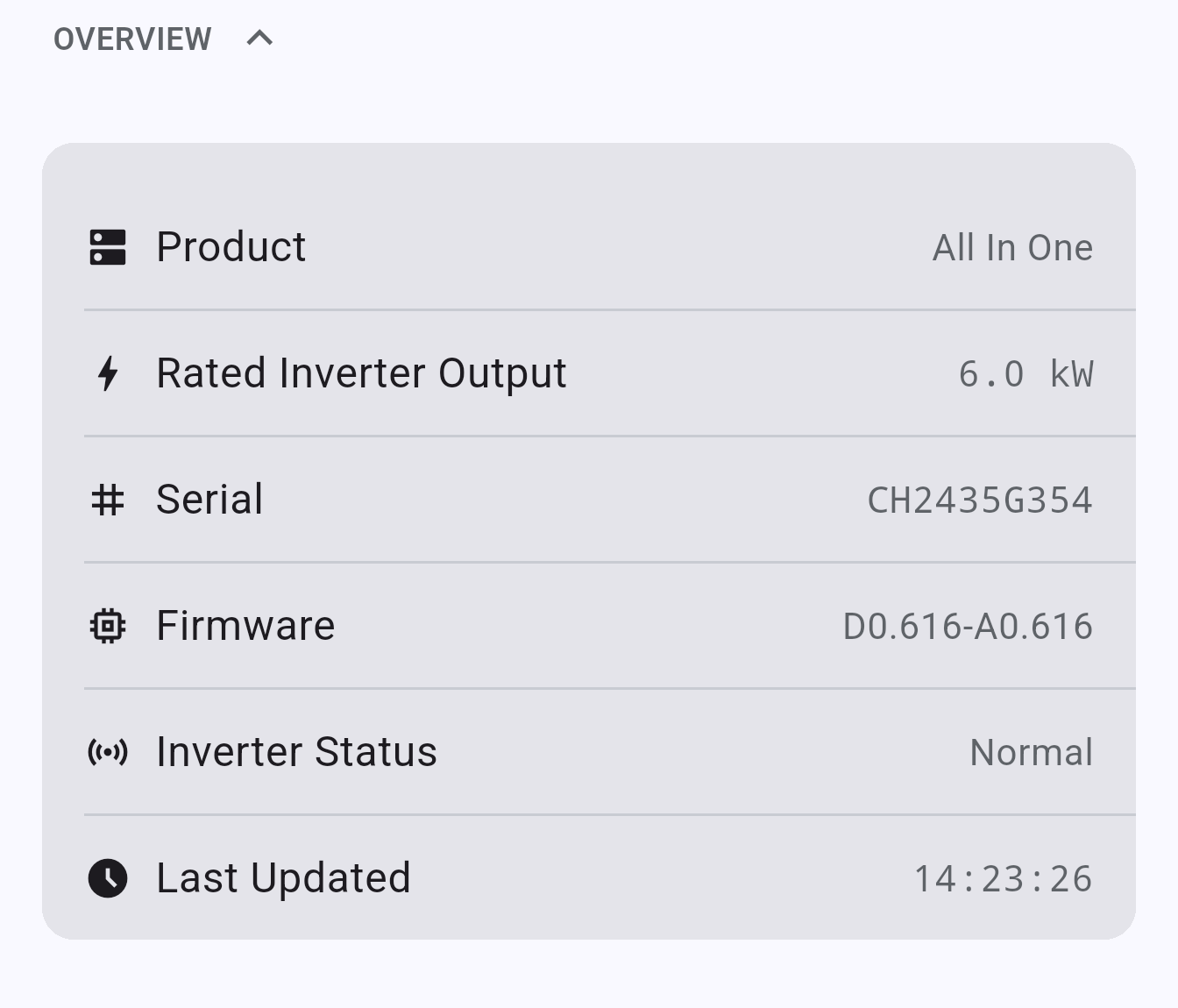
Overview
Section titled “Overview”| Field | Description |
|---|---|
| Product | Device type (e.g. Gateway, All In One, Hybrid GEN3) |
| Serial | Device serial number |
| Firmware | Installed firmware version |
| Status | Current inverter status (e.g. On Grid, Off Grid) |
| Last Updated | Timestamp of the most recent data read |
Fault Log
Section titled “Fault Log”Lists active and historical faults reported by the inverter. Faults can be reviewed and alerts cleared from here. See Fault Log for full details.
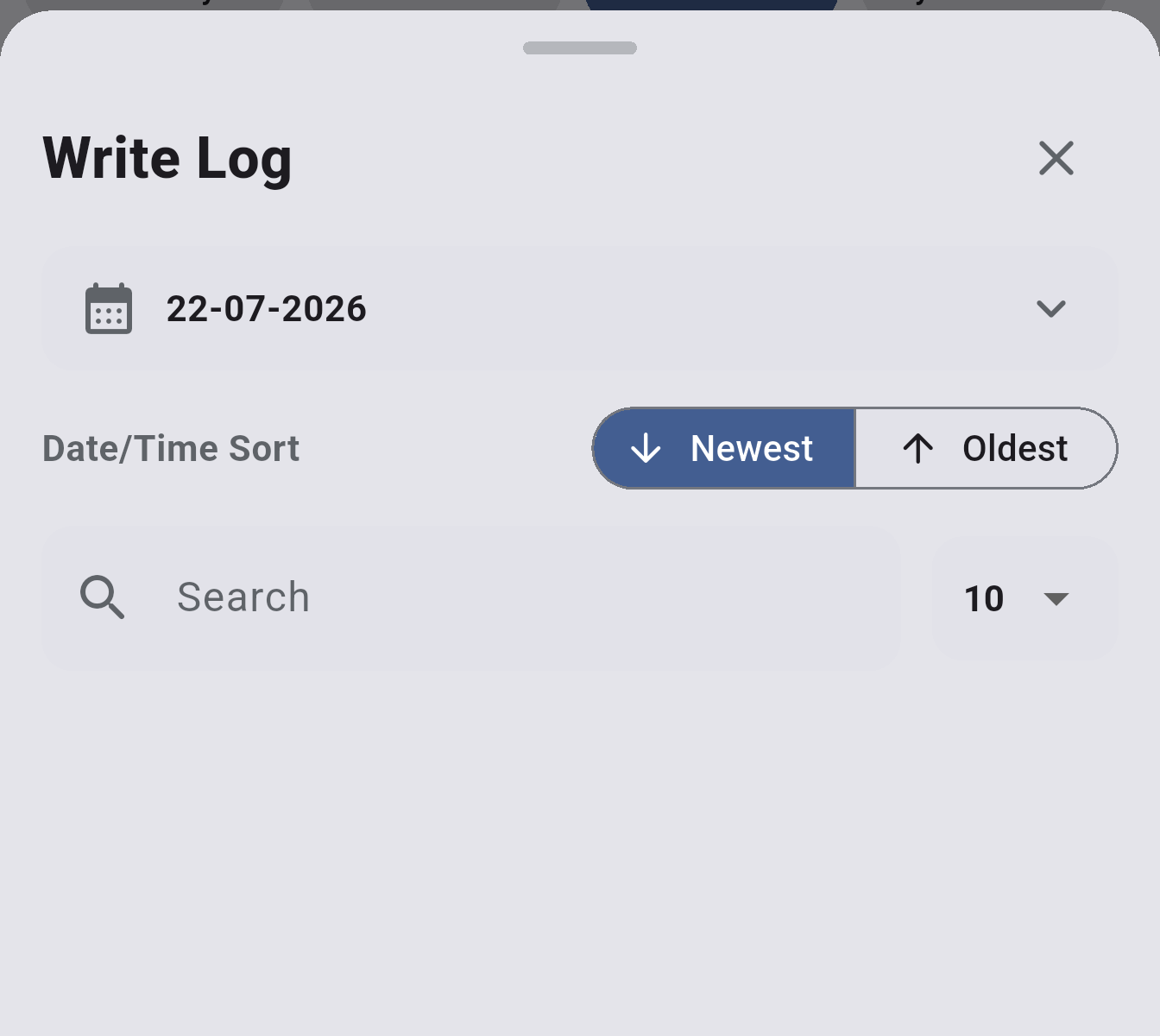
Write Log
Section titled “Write Log”A timestamped record of every setting written to the inverter from INVLocal. Each entry shows the register address, the value written, and the time. The log can be searched, filtered by date or register number, and exported.
Useful for verifying that changes were applied, or for diagnosing unexpected behaviour after a settings change.
Live Telemetry
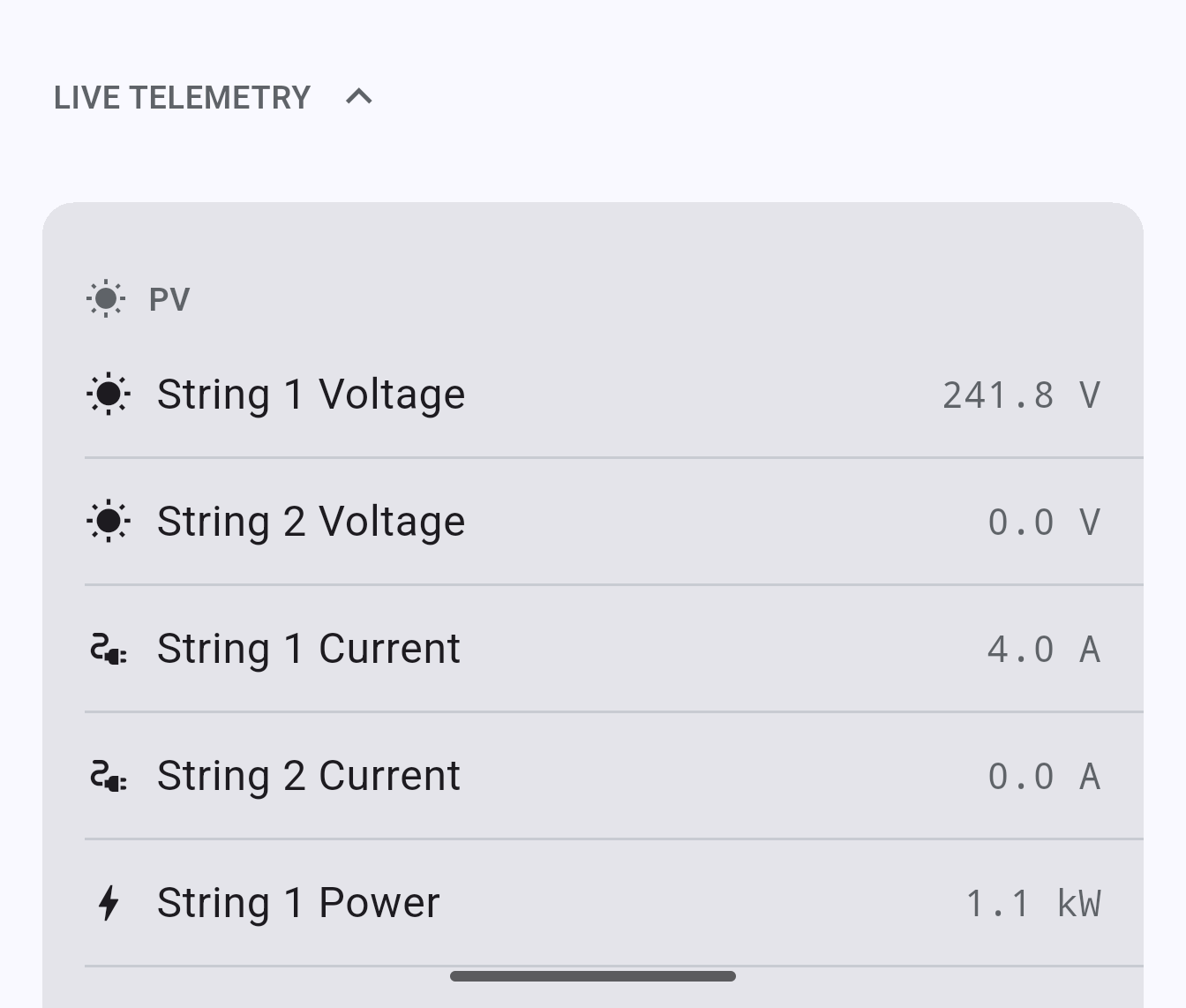
Section titled “Live Telemetry”Displays raw register values from the inverter in real time, grouped into categories:
- PV - solar input voltages and currents
- Grid - grid voltage, frequency, and power
- EPS - emergency power supply readings
- Temperature - inverter and battery temperature sensors
Battery Control
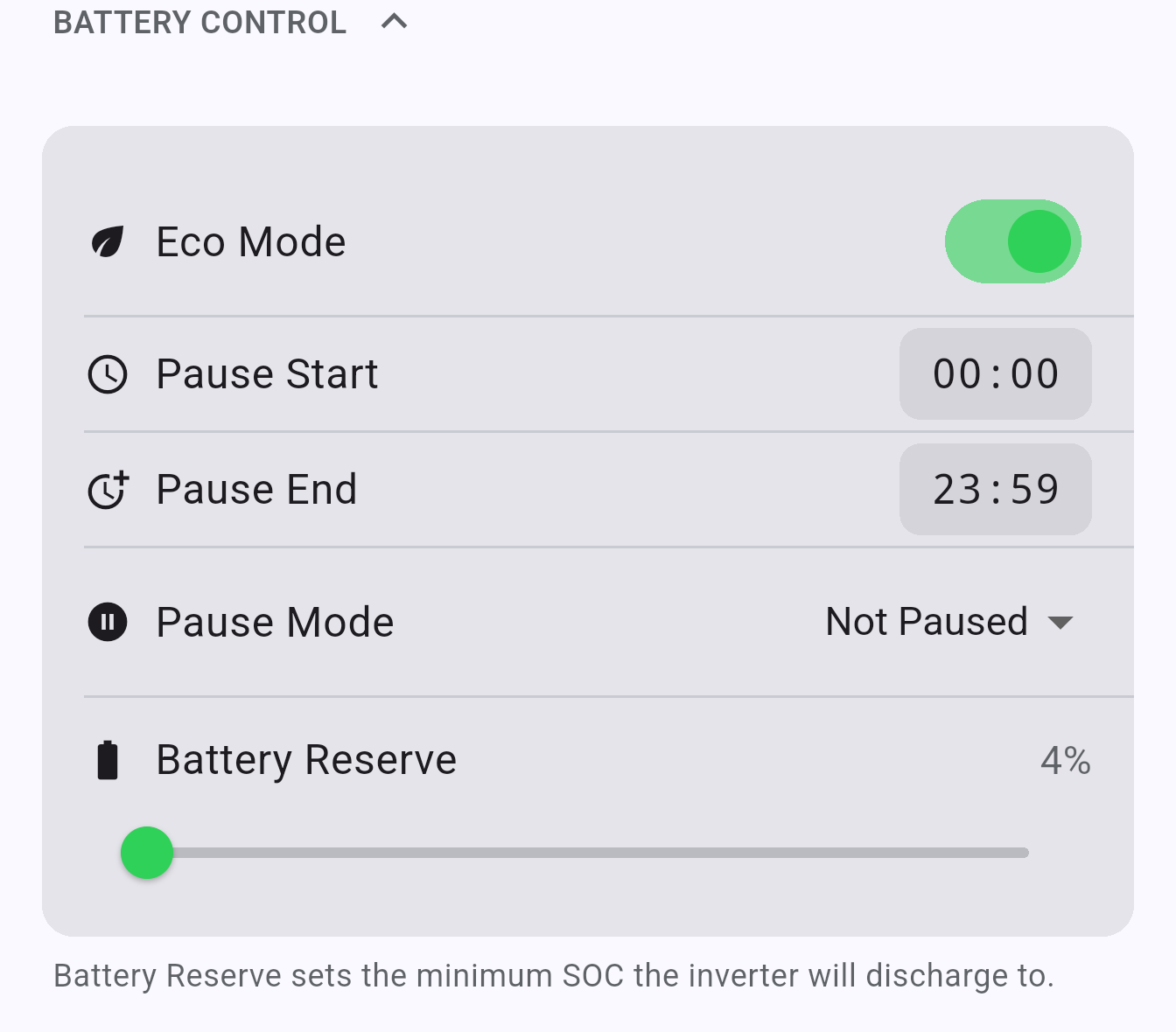
Section titled “Battery Control”| Setting | Description |
|---|---|
| Eco Mode | When enabled, the inverter automatically manages charge and discharge based on schedule and conditions. For most users this should stay on. |
| Battery Reserve | Minimum SOC the inverter will discharge to under normal operation (4–100%). Increase this to keep charge in reserve for a power cut. |
| Pause Start / End | Time window during which the battery is held |
| Pause Mode | Not Paused, Pause Charge, Pause Discharge, or Pause Charge & Discharge |
Power Limits
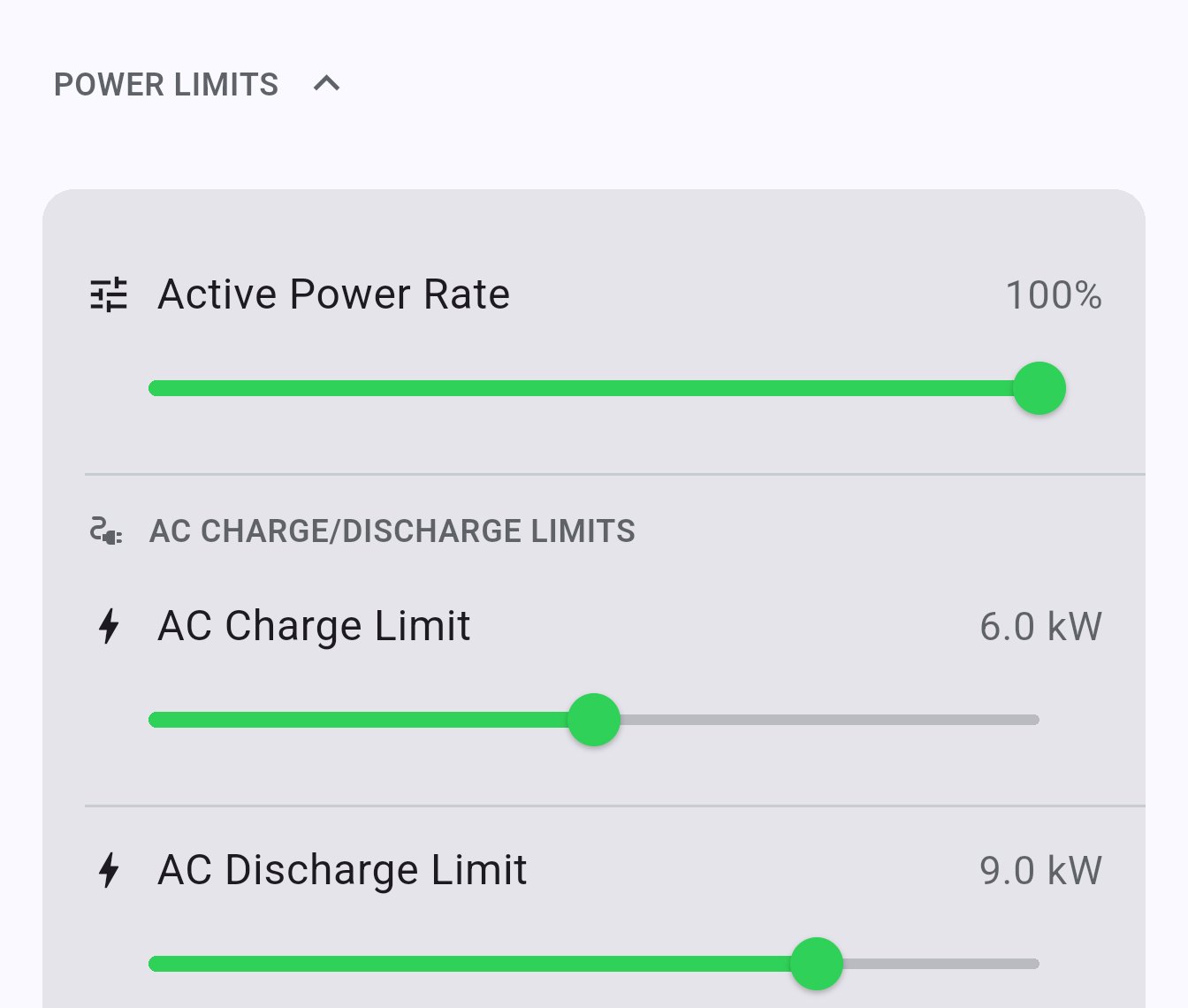
Section titled “Power Limits”| Setting | Description |
|---|---|
| Active Power Rate | Overall inverter output as a percentage of its rated capacity (%). Reduce to cap output for export limiting or grid compliance. |
| Charge Power Limit | Maximum battery charge rate in watts. Setting to 0 disables battery charging entirely. |
| Discharge Power Limit | Maximum battery discharge rate in watts. |
The maximum values available on these sliders reflect your inverter’s hardware specifications and battery configuration.
EMS Controls
Section titled “EMS Controls”Available on EMS devices only.
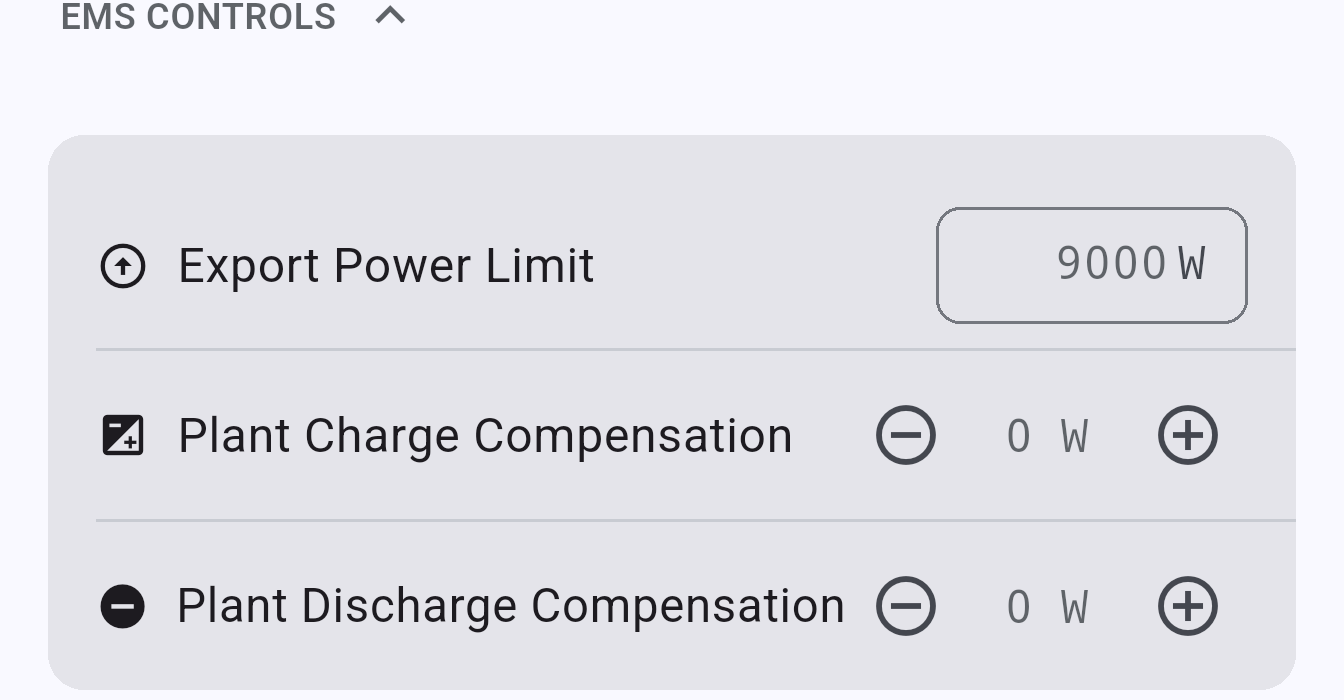
| Setting | Description |
|---|---|
| Export Power Limit | Maximum power the plant is allowed to export to the grid, in watts |
| Plant Charge Compensation | Fine-tune the charge target by a small offset (±5 W) to account for measurement differences between the EMS and individual inverters |
| Plant Discharge Compensation | Fine-tune the discharge target by a small offset (±5 W) |
Displays your phone’s current time alongside the inverter’s internal clock. Tap Sync to write your phone’s time to the inverter. Keeping the inverter clock accurate matters for schedule execution.
Automatic skew detection - when the app connects, it compares the inverter clock against the phone time. If the difference exceeds two minutes, a prompt appears asking whether to sync. The prompt appears at most once per day.
Advanced
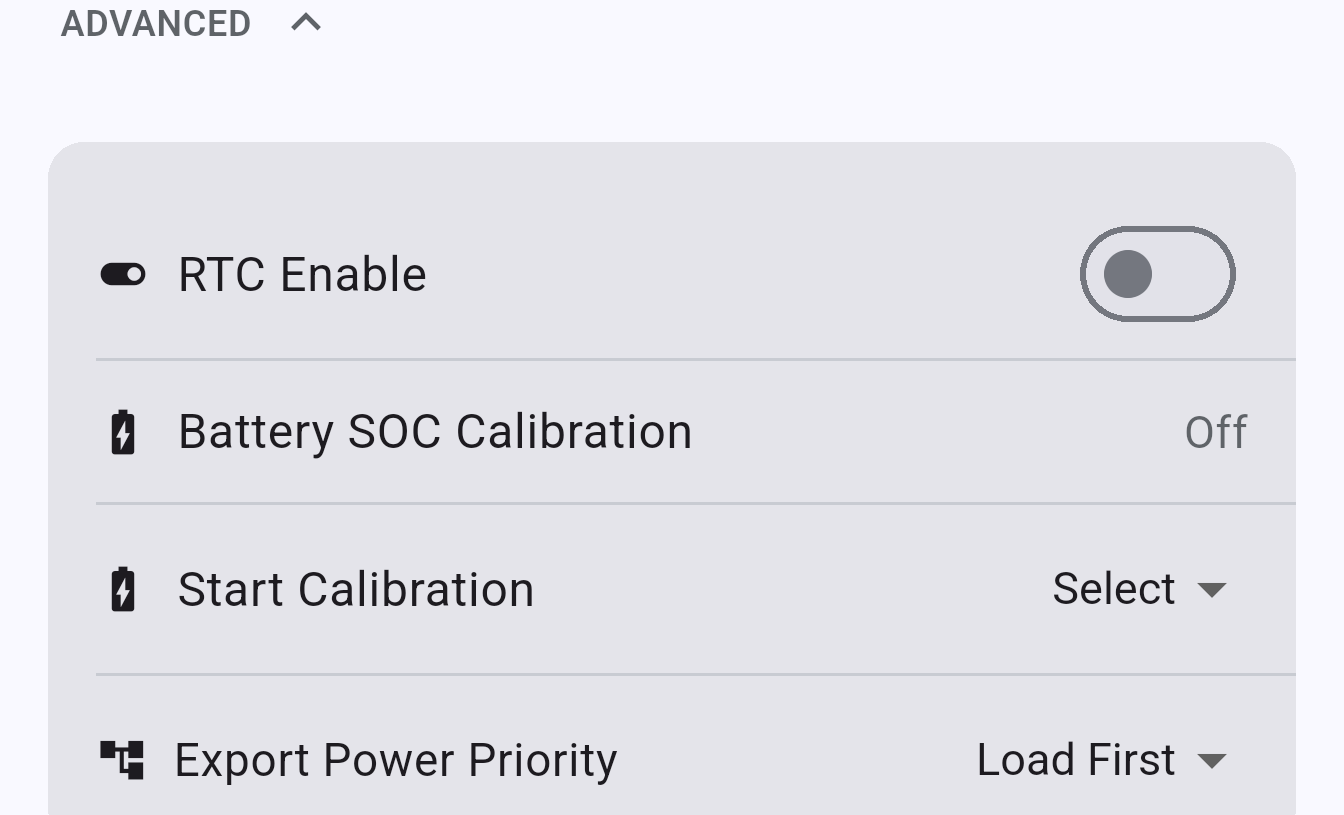
Section titled “Advanced”Export Power Priority - controls what the inverter prioritises when generating excess power:
| Value | Behaviour |
|---|---|
| 0 - PV First | Solar goes to loads before anything else |
| 1 - Load First | Loads are satisfied first, then battery, then export |
| 2 - Battery First | Battery is charged before exporting |
Battery SOC Calibration - if your battery state of charge reading has drifted, you can run a calibration cycle here. Choose Full (charge to 100% then discharge) or Charge Only (charge to 100%), then tap Start. Tap Stop when complete. This is a slow process that can take many hours.
Real-Time Control (RTC) - enables or disables real-time control mode. Only available on supported devices and firmware versions.
Grid Compliance
Section titled “Grid Compliance”| Setting | Description |
|---|---|
| EPS Mode | Enables Emergency Power Supply (off-grid backup) mode. Only appears on supported inverters. |
| Zero Second EPS Changeover | Enables near-instantaneous switchover to battery during an outage rather than the standard brief interruption |
Service
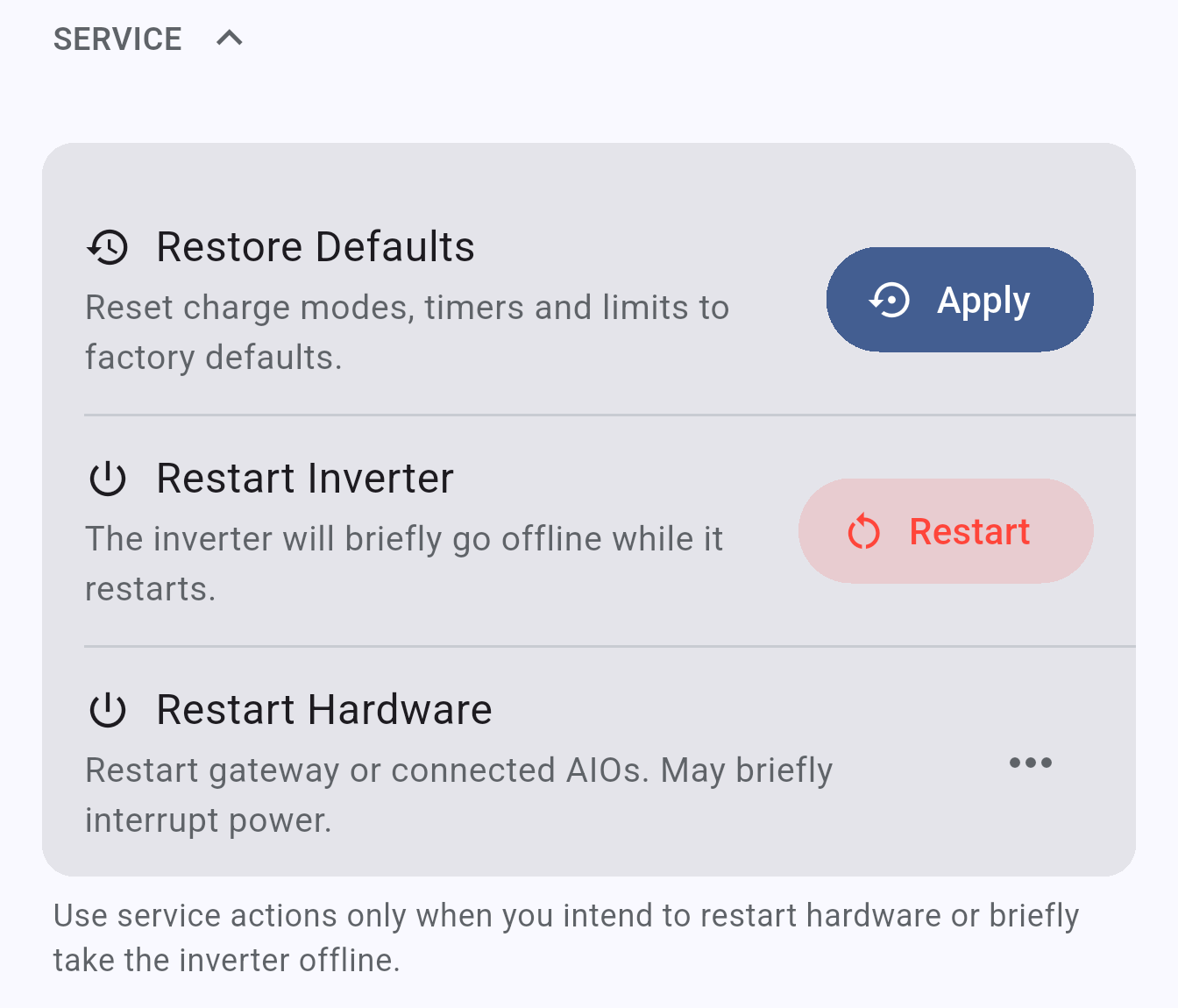
Section titled “Service”Restore Defaults - writes a fixed set of values directly to the inverter’s holding registers, returning operational settings to a known baseline. Useful after testing or after a quick action has left the inverter in a non-standard state.
Values written on restore:
| Setting | Reset value |
|---|---|
| Eco Mode | Enabled |
| Charge schedule enabled | Off |
| Discharge schedule enabled | Off |
| Battery Reserve | 4% |
| Active Power Rate | 100% |
| Battery Pause Mode | Not Paused |
| Battery SOC Calibration | Reset |
Power limits are reset differently by type:
| Inverter type | Charge Power Limit | Discharge Power Limit |
|---|---|---|
| Hybrid / All-in-One / AC-Coupled / EMS | 50% | 50% |
| Gateway | 100% | 100% |
Corrupt slot detection - after applying defaults, the app reads back all slots. If any contain an invalid time value (a known firmware quirk where minutes is set to 60), the app automatically clears those slots and logs the action.
Restart Inverter - sends a software restart command. The inverter will briefly go offline.
Restart Hardware (Gateway systems only) - separate options to restart the Gateway, connected AIOs individually, or everything at once.
Commissioning (Installer tier)
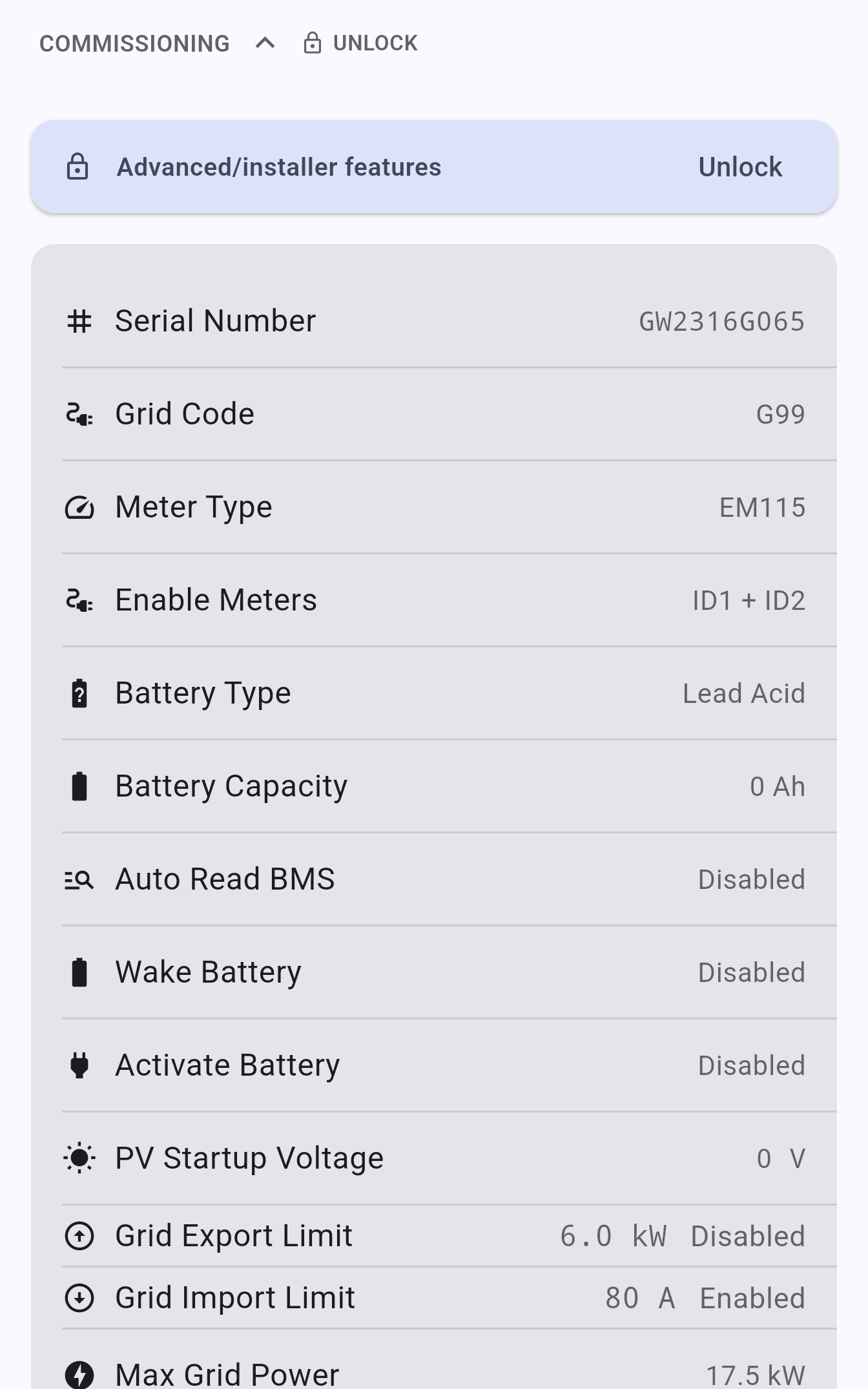
Section titled “Commissioning (Installer tier)”This section requires the Installer tier and covers settings typically configured once during installation. A confirmation prompt appears before any write is sent. This can be disabled in Settings → General → Confirm Commissioning Writes.
| Setting | Description |
|---|---|
| Grid Code | Grid compliance standard for your country/region (0–29) |
| Meter Type | CT clamps or energy meter (EM418/EM115) |
| Battery Type | Lead Acid or Lithium-ion |
| Auto Read Battery Type | Whether the inverter auto-detects the battery type instead of using the fixed setting above |
| Battery Capacity | Total battery capacity in amp-hours |
| Auto Read BMS | Whether the inverter reads SOC directly from the BMS |
| PV Startup Voltage | Voltage at which the inverter begins accepting solar input |
| Grid Export Limit | Maximum export power in watts |
| Grid Import Current Limit | Maximum import current in amps |
| PV Input Mode | Independent Strings (separate MPPT per string) or Combined |
| CT Direction | Flip the CT clamp reading if it’s showing negative when it should be positive |
| Force Off Grid | Isolates the inverter from the grid - use with care |
Diagnostics
Section titled “Diagnostics”Tools for troubleshooting. None of these change inverter settings.
Register Reader - read a specific register by address and slave ID. Choose Input Register (IR) or Holding Register (HR), enter the address, and tap Read. The raw value is shown immediately.
Register Dump - reads every register on the inverter and saves the result to a file. Useful when reporting a problem or comparing states before and after a change.
Plant Dump - like Register Dump, but covers all inverters in a multi-inverter plant.
Register Sweep - scans all registers and lists only those with non-zero values. A quicker way to find active or changed registers without wading through the full dump.
INVLocal is an independent product. It is not affiliated with, endorsed by, or supported by GivEnergy. GivEnergy is a trade mark of its owner and is used here only to describe hardware compatibility.